Showing posts with label India. Show all posts

Friday, 8 January 2010

"Report on Gaming in India 2009" released

Report on Gaming in India 2009 (PDF)

Hardware sales of Console devices, including parallel grey market for PS2, PS3, PSP, Xbox360 and Nintendo) is estimated at INR 2650 Million in 2008 and INR 4050 Million [in 2009] – rate of growth of 57% and 52% respectively. The sales of this hardware will continue to grow at 41% and reach INR 5750 Million in 2010.


Hardware value (including unofficial imports):

2009: 4,050M INR ($88.5M)
2008: 2,650M INR ($57.9M)

2010 forecast: 5,750M INR ($125.7M)

Saturday, 5 December 2009

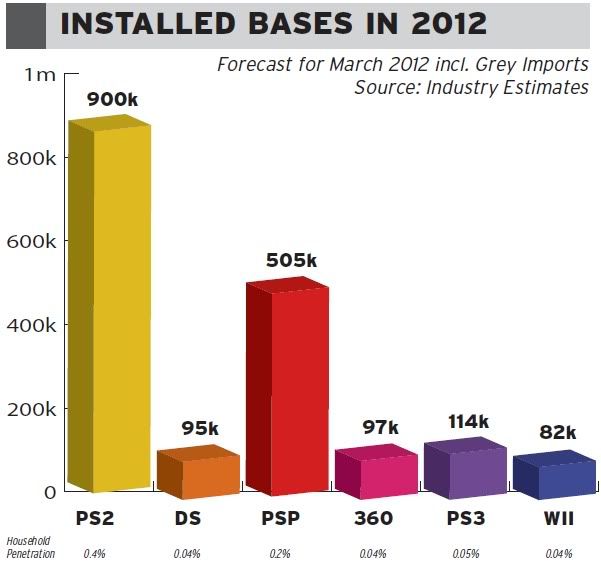
Indian installed base and total market estimates

MCV's full Indian Market Report can be read on page 29 of this PDF.

MARKET OVERVIEW

Chris Stanton-Jones
Catapult Business Solutions

Culturally, gaming is a new phenomenon for the Indian market. Although it has been present in India since the early days, games have traditionally been quite niche with PC the largest format. It has also been dominated by high piracy and a very under-developed retail environment, while the main import channel was previously an uncontrolled grey one.

Furthermore, it has been quite difficult for games to emerge from the overpowering dominance that Bollywood holds over entertainment in the home and getting acceptability from the parents has and will continue to be one of the key challenges to making the market mainstream.

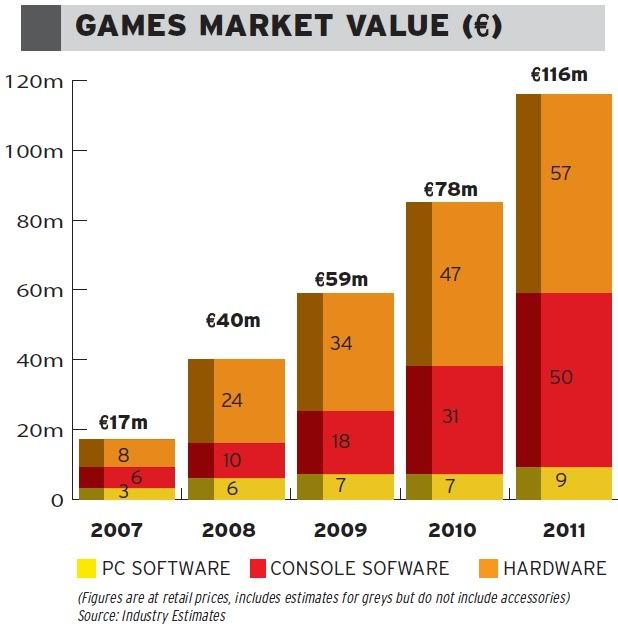
Nevertheless, what is clear now is that the games market is advancing with substantial growth in the last two years and further growth predicted. Although there is no official data, industry estimates value the market at a substantial €40m with it expected to double to €80m in the next two years. NASSCOM, India’s trade body for IT, had an even more upbeat prediction that the console gaming market would be €96m in 2010.

There are several factors that have helped the market growth, including the drastic rise in disposable income, the increasing mall culture, the organised presence of Sony, Microsoft and EA, release date parity with Europe, and platform holders heavily subsidising console pricing.

In a highly pirated market, software pricing is also key and locally replicated PS2 games can now sell for the magic price point of 499 INR (€8). Furthermore, Sony have invested in localised content of their own games (including SingStar Bollywood and Buzz Maha) and heavily encouraged local game development with the first result emerging in the form of PS2 title Hanuman.

There are still some market concerns including a largely negative economical mind-set, a lack of clarity on Nintendo's plans, high piracy and a current low rate of return for third party publishers – although revenues and profits are sure to increase as the market grows further.

Going forward, however, the future is very bright and the Indian games market will continue to be one of the fastest growing in the world pushed heavily by investments from the key players such as Sony.


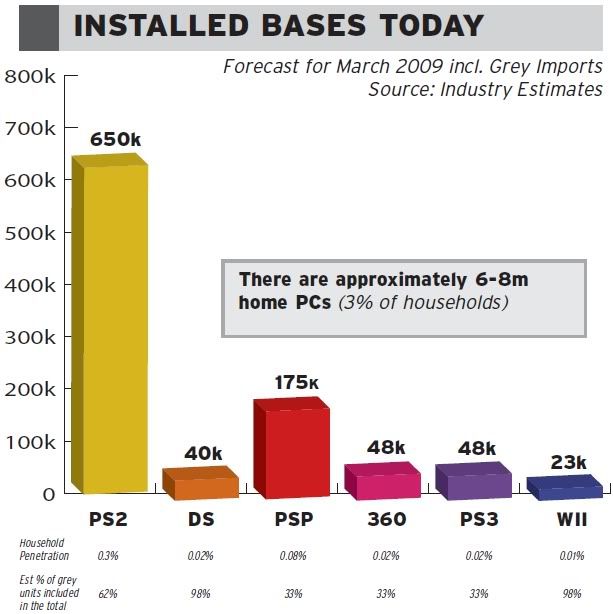
These estimates include unofficial "grey imports".


Here a percentage is given for the estimated number of unofficial "grey imports", note that Nintendo do not have an official presence in India. These figures are through March 2009:

Total estimated official and unofficial units:

PS2: 650,000
PSP: 175,000
PS3: 48,000
360: 48,000
NDS: 40,000
WII: 23,000

Total estimated official units:

PS2: 247,000
PSP: 117,000
PS3: 32,000
360: 32,000

Total estimated unofficial units:

PS2: 403,000
PSP: 58,000
NDS: 40,000
WII: 23,000
PS3: 16,000
360: 16,000

Wednesday, 11 November 2009

Annual Indian Playstation hardware sales

In an interesting interview with SCE's Indian manager, Atindriya Bose he reveals combined annual sales for PS2, PS3, and PSP in India:

It’s been nine years since PS2 was launched in India. There’s some fear that the games collection would dry up. Will you go back to the catalogue of old games or invest in developing new content?

It’s a combination of both for India because in this market PlayStation still has a long way to go. Indian developers and our partnership with them is working fine in bringing newer content and content we can take to international markets.

Desi Adda: Games of India, which features traditional Indian games such as Pachisi, Kite Flight and Kabbadi, among others, for example, will also be launched in South Africa, Middle East markets and the UK.

The second is the catalogue strategy. Even though PS2 was launched in 2001 in India, it has only picked up steam in the last two years where the market actually grew. This catalogue approach has worked well here because you can be selective and bring in stuff that is suited to this market.

How has PlayStation done in India?

On an annual basis, all consoles put together (PSP, PS2 and PS3), we now sell 300,000 consoles every year. Of this, PS2 and the PSP account for 80% of units sold.
In terms of market drivers and penetration, PlayStation2 has now gone even beyond the Top 20 cities, followed by PSP, while the PS3 is still a top 10 metro phenomenon.

Keeping this in mind, the content being developed here is largely for PS2 and PSP, as it has been developed for new gamers and has been designed of them. For PS3, international content strategy works very well.

Desi Adda, which showcases six traditional Indian games, has been developed for PSP and PS2 in three languages—Hindi, Tamil and Punjabi —and the price points for these and the content are targeted at new gamers.

While the challenges are elaborate enough, you don’t want depth of game—which is 70-80 hours—which can push up the price. So, while there is certain limit on game play, it definitely matches international standards. While the recession did slow things for everyone, the rate of growth has bounced back, with impressive sales during the back-to-school season and Diwali this year.


Full interview


From an Indian gaming event in February:

Amidst all this jury duty, I also found time to attend some of the sessions on the gaming industry. The most interesting thing, for me, to emerge here was that, for the first time in a conference like this, Microsoft and Sony were willing to share some unofficial sales figures. Microsoft shared an unofficial figure of ‘less than 100,000’ XBOX units (of course, that could even be 5,000). Sony claimed around 400,000 PS2s, 120,000 PSPs and 35,000 PS3 units sold. While these figures don’t sound very high in light of worldwide figures, it’s still a start. And it’s up to us to get them up — so each of you go out and convince all your friends to buy game consoles!


Link

Note that Nintendo do not officially operate in India.